
Proving Fault in Intersection Accidents in Malaysia: How Car Accident Lawyers Use Proof and Testimony?
Crossing accidents are one of the most complex and controversial types of traffic incidents. Determining who is at fault can have a major impact on whether a claim is accepted or denied, whether it involves a T-bone collision, a collision during a left turn, or a side collision at a busy intersection. In Malaysia's civil liability framework, based on tort law, culpability is assessed through evidence and legal analysis rather than mere assumptions.
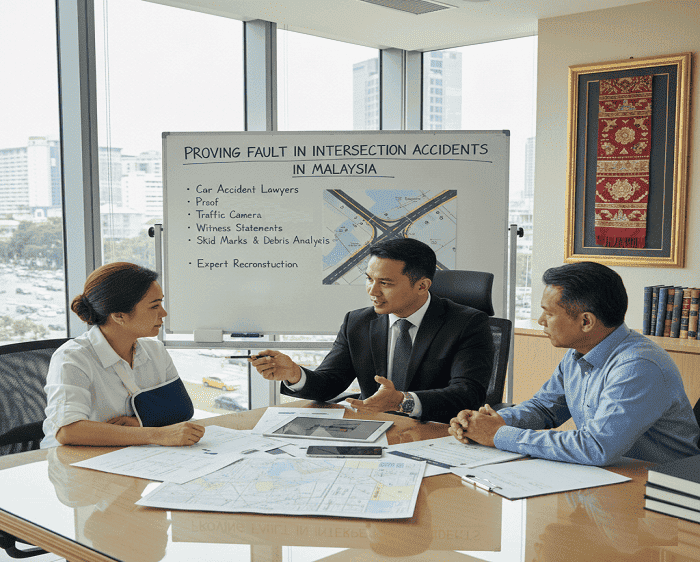
Legal framework: Negligence and duty of care
Under Malaysian law, the primary basis for most claims arising from motor vehicle incidents is negligence. This shows that the driver breached the duty to drive with care, causing damage to other people. The actions taken are what a responsible driver would have taken in comparable circumstances.
This is an important point: Being involved in an accident does not automatically indicate guilt. According to Malaysian jurisprudence, the burden of proof lies with the claimant (based on probability) that the negligent acts of the other party caused the accident; Courts will not consider negligence simply because an accident occurs.
Because of this, an experienced car accident attorney knows that proving guilt requires more evidence than eyewitness testimony. This can include obtaining expert testimony, solid evidence, and an accurate accident reconstruction to build a compelling case that shows the victim is innocent and deserving of both justice and compensation.
Immediate evidence: Police report and crime scene documentation
Analysis of any fault begins at the scene of the accident.
Official details of the incident are provided by police reports, which include information about the vehicle's location, traffic signs, signal conditions and observations made by witnesses and drivers. These records are often important for legal proceedings as well as insurance related matters.
Damage to vehicles, skid marks, traffic signals, road conditions and junction arrangements are recorded on photographs and video recordings immediately after the incident. These visual aids help lawyers reconstruct events and support or refute the claims of each side.
Drivers in Malaysia are required to stop, exchange information and report collisions to the authorities. This report is often used as evidence in subsequent legal proceedings.
Right of way and record of traffic violations
An important component in intersection incidents is who had the right of way. Lawyer will examine:
• Whether the driver disregarded a red light or stop signal.
• Did not get the correct result when flipping a vehicle.
• If a driver drove into an intersection without sufficient visibility or good judgment.
Dashcam footage, CCTV footage and traffic signal information are examples of evidence that can conclusively show that the driver broke a traffic law or had a green light. In many international cases, the acquisition of signal time logs or camera footage has proven important in determining liability.
A dashcam in particular acts as a "digital witness", recording key moments that can either refute or validate claims presented by the parties involved.
Testimony: Confirms the sequence of events
Other drivers, pedestrians and bystanders are examples of eyewitnesses who can provide significant assistance. Their statements help lawyers create a chronology of events and:
• Confirm which vehicle entered the intersection first.
• Describe reckless driving (such as speeding or distraction).
• Verify the status of signals and movements of each vehicle.
Obtaining witness contact information as soon as possible after an accident increases the credibility of their testimony in subsequent trials or discussions.
Lawyers usually collect written or recorded statements at the beginning of proceedings because human memories fade and descriptions can become less reliable over time.
Technical and forensic evidence
These days, accident investigations often include more than just photos and eyewitness reports:
To recreate accidents and determine the speed, location of the impact and potential failure dynamics, accident reconstruction experts use data from visual and physics concepts.
Inspection of vehicles can reveal technical problems, brake condition and collision angles, and provides a more comprehensive story than purely subjective accounts.
Expert testimony can have a particularly significant impact on controversial cases because it provides an objective professional assessment of concrete facts.
Mobile phones and electronic data
Records of mobile phone and car telematics, or "black box" data, can be crucial in proving distraction, excessive speed or failure to stop in our connected world.
For example, phone records may show that a driver was texting right before a crash, supporting allegations of distracted driving. Similarly, the driver's version of events can be challenged by speed and braking data from on-board devices.
Counterclaims and prerequisites
In order to minimize damages, insurance companies routinely dispute cases and deny liability. They may claim that the incidents were fabricated, that other cars stopped suddenly, or even contributory negligence. Res ipsa locitur, or the idea that "the thing speaks for itself", does not always apply in Malaysian courts; The claimant will have to provide concrete evidence.
Lawyers prepare to refute these claims by pointing out contradictions, using expert analysis and demonstrating that the contrary statements lack sufficient evidence.
Cross-examination and legal strategy
Testimony becomes much more important when cases go to trial. Lawyers will carefully:
Cross-examine drivers and investigators to draw attention to reckless behavior (such as speeding, being distracted, or ignoring signals).
• Draw attention to the difference between reports and concrete evidence.
• Call expert witnesses to help courts understand complex technical matters.
• Skilled questioning can reveal negligent conduct or reveal flaws in the other party's story.
Contributory negligence and transfer of responsibility
Malaysian courts have the authority to assign liability even in situations where both drivers show some degree of negligence (for example, one disobeying a light while the other was speeding). In the documented cases, the distribution of compensation – for example 70% to one driver and 30% to the other – is determined by the driver's actions during the accident.
This holistic technique ensures that compensation is based on actual fault rather than overly simplistic decisions.
Conclusion
In Malaysia, establishing liability in intersection accidents requires careful gathering of evidence, strategic use of testimony and application of negligently derived legal principles. Lawyers are essential in piecing together the technical, human and physical elements of an accident to show how negligence caused injury.
Even in the most contentious crossroads situations, attorneys help accident victims and insurance reach fair settlements through thorough documentation, credible witnesses, expert evaluations and skilled courtroom strategies.
About the Author
Tod Malicoat is an Analyst. He loves to share his thoughts on trending laws, Business etc. He is passionate about new gadgets. In his free time, he loves to travel and explore new areas.
Edited by: Ch. Mahmood Anwar (PhD)
Do comment if you find this article interesting.


